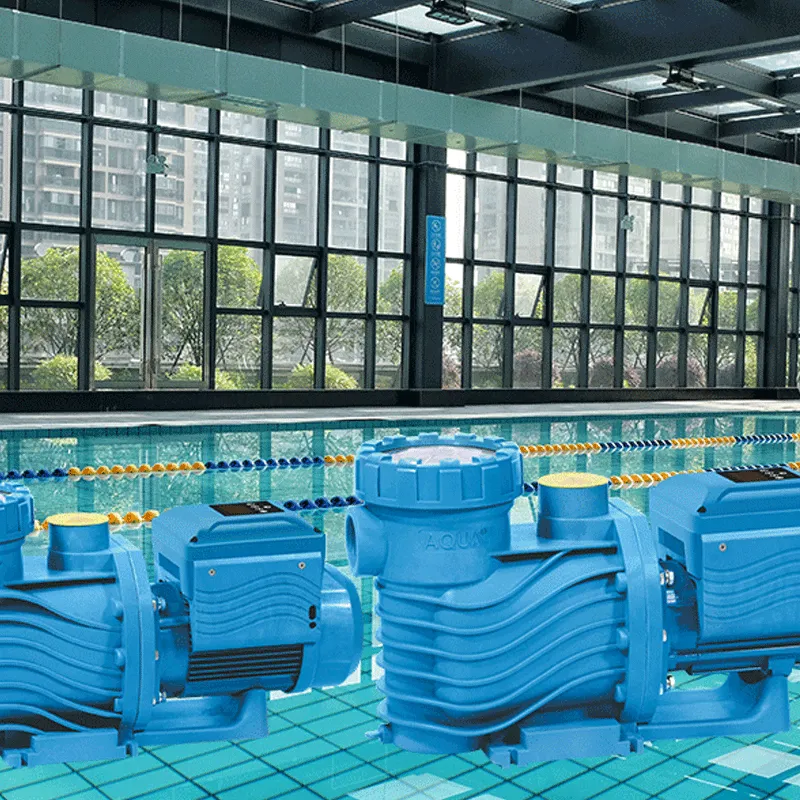
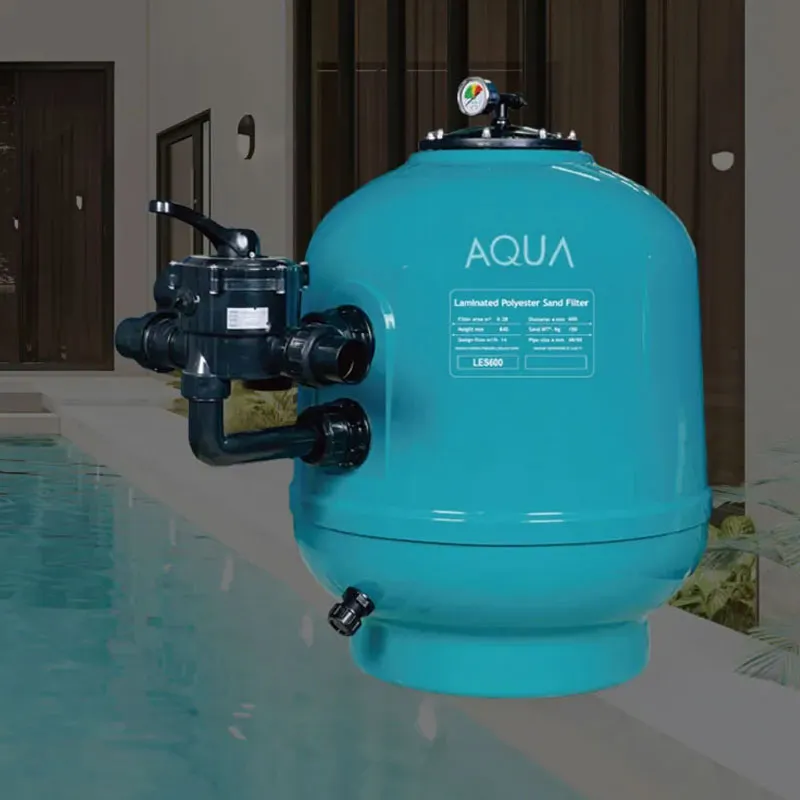
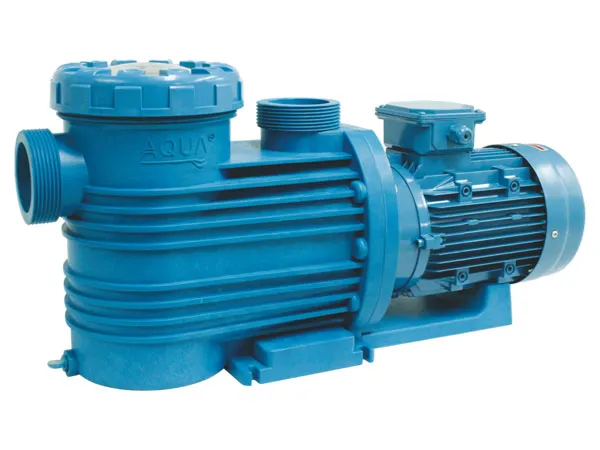
Choosing a swimming pool equipment supplier is a supply-chain decision, not simply a product-price comparison. A buyer may need pumps, filtration, heat pumps, disinfection, lighting, cleaning tools and fittings to work together on one project, and each category can involve different electrical, hydraulic and certification requirements. A supplier that cannot coordinate these interfaces can create extra engineering work even when individual products appear competitively priced.
For distributors, contractors, hotel projects, aquatic facilities and OEM buyers, the evaluation should therefore cover manufacturing capability, product scope, quality systems, technical documentation, testing, customization, delivery and after-sales support. The most useful supplier is one that can provide evidence for these areas and translate a project specification into an equipment package that is easy to install and service.
AQUA is a China-based swimming-pool equipment brand whose current portfolio covers pumps, filtration, heating and cooling, disinfection, lights, cleaning equipment, fittings and accessories. According to the company's current profile, AQUA was founded in 1999 and operates production and research facilities totaling about 40,000 m². This guide uses a structured procurement approach to explain what buyers should verify before placing a project or distribution order.
What Should a Swimming Pool Equipment Supplier Provide?
A swimming pool equipment supplier should provide compatible products, verifiable technical data, quality documentation and project support that allow a buyer to select, install and maintain the equipment correctly.
A broad catalogue alone is not enough. The supplier should be able to identify the correct pump duty, filter flow, heat-pump operating conditions, disinfection flow range, light voltage and fitting standards. When a project contains several equipment categories, the interfaces between them become part of the supplier's value.
Documentation is equally important. Product data sheets should state model numbers, dimensions, materials, electrical requirements, working pressure, temperature limits and performance data where applicable. Installation manuals should explain connections and clearances. Certificates should identify the relevant product or product family rather than being unrelated company documents.
For repeat B2B purchasing, the supplier should also offer a stable process for quotation, sample approval, order confirmation, production inspection, packing, shipping documents and after-sales claims. A distributor may buy the same product for several years, so consistency can be more valuable than a one-time low price.
How to Verify a Swimming Pool Equipment Supplier in China
Verifying a swimming pool equipment supplier in China means checking whether the company, factory, technical capabilities and certifications match the claims made in its quotation and website.
Start with the legal company name and factory information. Ask which products are manufactured internally, which are assembled from purchased components and which are sourced from external partners. A company can still be a useful system supplier without making every component itself, but the buyer should understand where quality responsibility sits.
Factory evidence should be specific. AQUA's current company profile states that its production and research footprint is about 40,000 m² and that monthly output across its equipment operations is approximately 7,000–10,000 units. The same profile lists four production bases. These figures create useful questions for due diligence: which product families are made at each site, which tests are performed before shipment and what capacity is allocated to export orders?
When evaluating swimming pool equipment china suppliers, buyers should request current factory photos or video, production-line information, test records and the exact address of the facility relevant to the ordered products. For major projects or long-term distribution agreements, a third-party audit or in-person visit can further reduce supply risk.
Website history and product depth can provide supporting evidence but should not replace verification. A genuine manufacturer should be able to answer detailed questions about materials, manufacturing tolerances, pressure tests, electrical configurations and quality-control checkpoints without relying only on marketing language.
Swimming Pool Equipment Supplier vs Manufacturer vs Trading Company
A swimming pool equipment supplier can be a manufacturer, a trading company or an integrated system provider, and each model offers different advantages for B2B procurement.
| Supplier Type | Main Strength | Possible Limitation | Best Fit |
|---|
| Specialized manufacturer | Deep control over one product category and production process | May not cover a complete pool-equipment package | Large-volume purchasing of a narrow product range |
| Trading company | Can source many categories and consolidate orders | Technical control and factory traceability may vary by supplier | Buyers prioritizing sourcing breadth and flexible consolidation |
| Integrated pool-equipment supplier | Coordinates pumps, filters, heating, disinfection, lights and fittings | Buyers still need to verify which products are made internally | Projects, distributors and contractors seeking system compatibility |
| OEM/ODM manufacturing partner | Supports private label, packaging and product adaptation | Development time, MOQ and tooling may be higher | Established brands building a differentiated product line |
For a single replacement pump, a specialized manufacturer may be sufficient. For a new hotel pool that requires filtration, heating, water-quality control and lighting, coordinating four or five separate vendors can increase engineering and logistics work. An integrated supplier can simplify that process if it has enough technical depth.
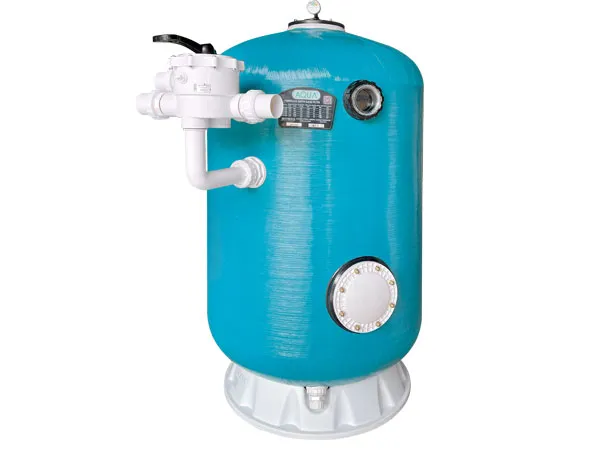
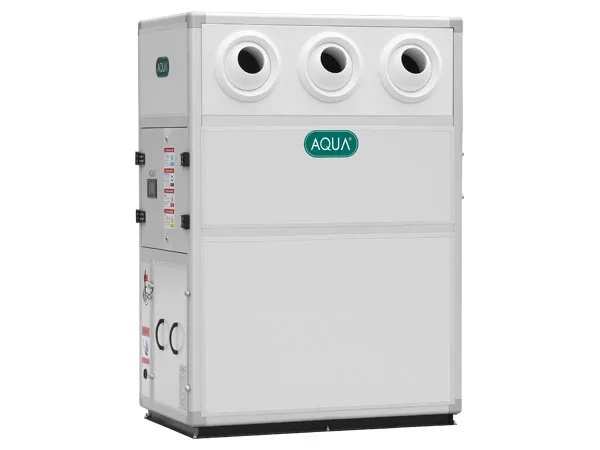
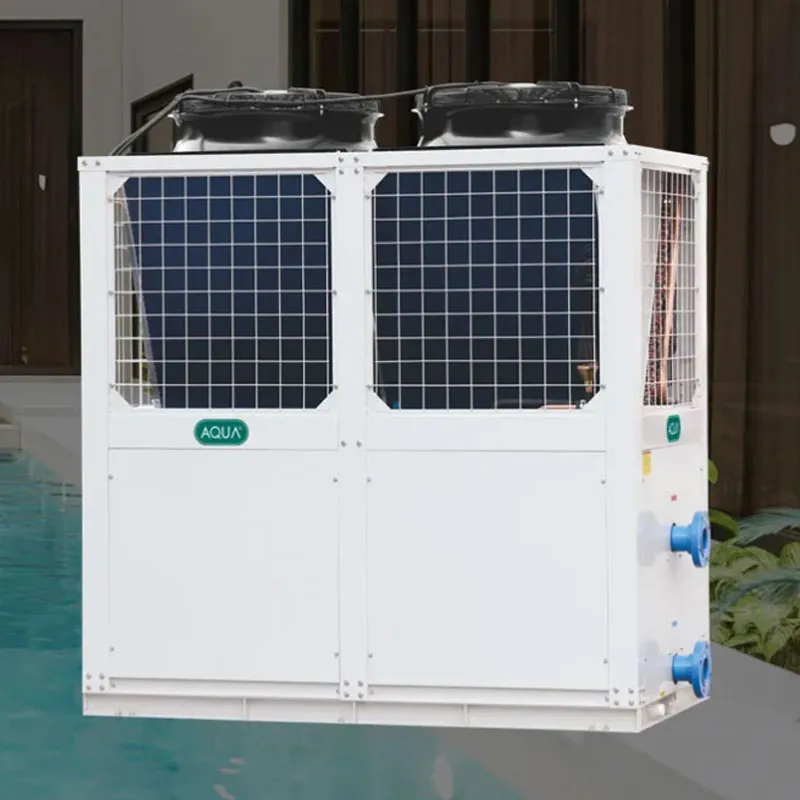
AQUA positions itself as an integrated pool-equipment supplier. Its current navigation includes circulation pumps, sand and cartridge filters, commercial filtration, heat pumps and chillers, UV and ozone treatment, automatic dosing, pool lights, cleaning tools and fittings. This breadth can be useful when a buyer wants a coordinated package, but each item should still be evaluated against the project specification.
How to Evaluate Product Range From a Swimming Pool Equipment Supplier
Evaluating a swimming pool equipment supplier's product range means checking whether the available categories cover the project's functions without forcing unsuitable products into the specification.
A complete pool equipment schedule usually starts with circulation and filtration. The pump must deliver the required flow at the calculated system head, while the filter must accept that flow within its rated filtration velocity. Heating or cooling equipment then adds its own water-flow and pressure-drop limits.
Disinfection systems must be compatible with the circulation rate and treatment objective. Depending on the project, equipment may include dosing pumps, salt chlorination, UV, ozone or automated water-quality monitoring. Lighting adds electrical and control requirements, while fittings such as skimmers, drains, returns and valves determine how water moves through the pool.
If one supplier covers several categories, ask it to mark each component on a hydraulic or equipment schedule. A supplier should be able to explain why a pump, filter and heater are matched rather than simply offering models with similar connection sizes.
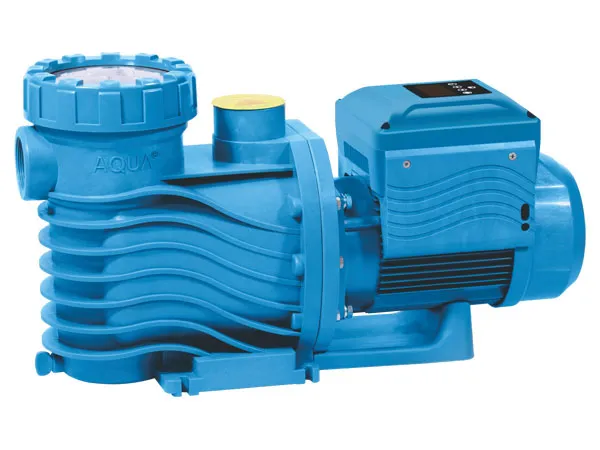
For buyers sourcing circulation systems, the AQUA swimming pool pump suppliers category includes professional filtration pumps, variable-speed pumps and air pumps. A supplier evaluation should go beyond model count and compare curves, materials, voltage options and after-sales parts for the intended market.
What Certifications Should a Swimming Pool Equipment Supplier Show?
A swimming pool equipment supplier should show current management-system and product-specific certifications that are relevant to the factory, product and destination market.
Management-system standards describe how an organization manages processes rather than certifying that every product meets every technical rule. ISO 9001 covers quality management systems. ISO 14001 covers environmental management systems, and ISO 45001 addresses occupational health and safety management.
AQUA's current company profile states that it has passed ISO 9001, ISO 14001 and ISO 45001 management-system certification. It also lists 256 quality certifications and more than 56 patents. These numbers should be treated as company-published figures and verified against current certificate copies when they are material to a tender or distributor agreement.
Product certification is different from management-system certification. A pool light, pump, heat pump or electrical controller may require market-specific testing and marks. Ask for the certificate number, issuing body, model scope, current validity and applicable standard. A certificate for one product series should not automatically be applied to a visually similar series.
The destination country determines what evidence matters. Before finalizing a purchase, the importer or project consultant should confirm local electrical, pressure, efficiency, safety and labeling requirements. The supplier can provide documents, but regulatory responsibility should be clearly assigned in the contract.
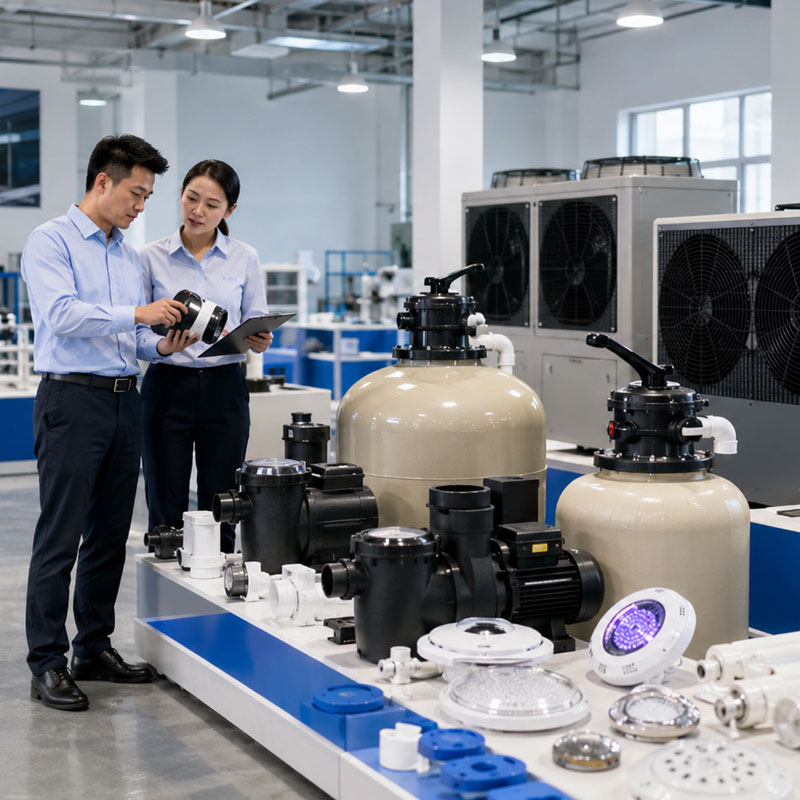
How to Assess Testing and Quality Control at a Swimming Pool Equipment Supplier
Assessing a swimming pool equipment supplier's quality control means checking which characteristics are inspected, how results are recorded and what happens when a product fails the acceptance criteria.
Different products require different tests. Pumps may be checked for hydraulic performance, electrical safety, leakage and noise. Filters can require pressure and leakage testing. Heat pumps may need refrigerant, electrical and operating checks. Underwater lights need sealing, electrical and functional verification. A generic final inspection cannot replace product-specific testing.
AQUA states that its laboratory performs pressure, corrosion-resistance and durability validation. Its company profile also describes quality control across the production process. For a serious B2B evaluation, ask for the inspection plan that applies to the actual ordered model and request a sample report with sensitive customer information removed.
Incoming-component control is also important. Motors, compressors, drivers, sensors, valves, seals and electronic boards can determine the reliability of the finished product. The buyer should understand whether critical components are traceable by batch or supplier and whether substitutions require approval.
For large orders, define pre-shipment inspection criteria in advance. The agreement can state sample size, visual acceptance, functional tests, documentation checks and packaging requirements. This turns "quality" from a general promise into measurable acceptance conditions.
For high-value orders, consider separating supplier qualification from order inspection. Qualification asks whether the factory is capable of producing the equipment consistently; pre-shipment inspection asks whether the actual order meets the approved specification. A factory can pass an audit and still make mistakes on a particular production batch, so the two controls should not be treated as interchangeable.
The purchasing contract should also define how engineering changes are handled. If a motor, compressor, electronic board, resin, seal or other critical component becomes unavailable, the supplier should not substitute it silently. A formal change-notification process gives the buyer an opportunity to review performance, certification and spare-parts implications before the revised configuration enters production.
Traceability becomes more important when equipment is sold under a distributor's own brand. Serial numbers, production dates or batch records can make warranty analysis much faster. When a field issue occurs, the distributor should be able to identify whether affected units came from the same component lot or production period instead of replacing all units without evidence.
How to Compare Technical Support From a Swimming Pool Equipment Supplier
Technical support from a swimming pool equipment supplier should help buyers convert project requirements into correct model selections, drawings and commissioning instructions.
A strong technical conversation starts with project data. For filtration, provide pool volume, turnover time, design flow and plant-room layout. For heating, include water temperature, climate and operating schedule. For lights, provide pool dimensions, wall type, voltage and control requirements. The supplier should identify missing information before recommending equipment.
Response quality matters more than response speed alone. A technically useful answer explains the selection logic, points to the relevant curve or table and identifies assumptions. If a supplier recommends a larger pump "for safety" without calculating system head, the buyer should ask for a hydraulic justification.
Drawings should be checked for dimensions, connections and service clearance. B2B buyers often discover too late that a filter cannot pass through the plant-room door or that a cartridge cannot be removed because the ceiling is too low. These details should be resolved before shipping.
Technical support continues after delivery. Commissioning guidance, fault-code interpretation, spare-parts identification and remote troubleshooting can reduce downtime. For distributors, training material and exploded diagrams make local service more efficient.
How to Evaluate Customization and OEM Capability
Customization from a swimming pool equipment supplier includes product configuration, electrical options, branding, packaging and documentation changes that are controlled without compromising performance or compliance.
Not every customization should involve changing the core product. For many distributors, the most valuable options are private labels, cartons, manuals, color schemes, accessories and voltage configurations. These changes can create a market-specific offering without requiring a new hydraulic or refrigeration design.
More substantial ODM work needs engineering control. If a buyer requests a different motor, heat exchanger, controller or enclosure, ask how the change is validated and whether existing certificates remain applicable. A modification that seems small commercially can affect safety, efficiency or regulatory scope.
Define the approval process in writing. The supplier should provide drawings, artwork or samples before mass production. The buyer should approve model naming, rating labels, packaging, manuals and accessories. Revision control prevents an old artwork file or outdated component specification from returning in a later order.
MOQ, tooling cost and lead time should be separated from normal production pricing. A transparent supplier explains which changes are available at standard MOQ and which require engineering investment.
How to Compare Price, MOQ and Delivery From a Swimming Pool Equipment Supplier
Commercial terms from a swimming pool equipment supplier should be compared on total landed value, supply reliability and included scope rather than unit price alone.
A low quotation may exclude accessories that another supplier includes. Pumps may be quoted without unions, filters without media, lights without transformers or heat pumps without controllers. Ask each bidder to identify included and excluded items so the comparison uses the same scope.
MOQ matters differently for projects and distributors. A project contractor may need several models in small quantities, while a distributor may accept larger quantities to secure better pricing or custom packaging. Ask whether different models can be mixed in one shipment and whether spare parts can be included without separate MOQ requirements.
AQUA's company profile states cumulative shipments of more than 1.5 million units. Historical shipment volume can indicate experience, but current order capacity and delivery reliability still need to be confirmed for the exact product family. Ask for production lead time, peak-season constraints and the point at which an order becomes non-cancellable.
For categories such as lighting, buyers can review the broader AQUA swimming pool light for sale range together with transformers and controls, which helps avoid receiving luminaires before the supporting electrical components have been specified.
Shipping preparation should include packaging dimensions, gross and net weight, pallet information and loading plans where relevant. For fragile equipment or long-distance sea freight, packaging quality is part of product quality.
Swimming Pool Equipment Supplier RFQ and Evaluation Checklist
A swimming pool equipment supplier RFQ checklist standardizes technical and commercial information so competing quotations can be evaluated on the same basis.
Legal company name, factory address and product-manufacturing location.
Product categories manufactured internally and categories sourced externally.
Model-specific data sheets, drawings and manuals.
Performance curves or test data where applicable.
Management-system and product-specific certifications.
Quality-control process and sample inspection reports.
Materials and critical-component brands or specifications.
Voltage, frequency and destination-market configurations.
OEM branding, packaging and documentation options.
MOQ by model and mixed-order policy.
Production lead time and pre-shipment inspection procedure.
Warranty scope, claim process and response time.
Recommended spare parts and spare-parts lead time.
Incoterms, packing data and shipping documentation.
Technical support available before and after delivery.
A weighted supplier scorecard can help a buying team avoid choosing only by price. For example, technical compliance and quality evidence can be assigned more weight than cosmetic customization, while a distributor may give additional weight to documentation, private label and spare-parts support.
For AQUA, the available product breadth, published factory information and management-system certifications provide useful starting evidence, but each project should still verify the exact product documentation and commercial terms before ordering.
Frequently Asked Questions About Choosing a Swimming Pool Equipment Supplier
The following FAQs address common questions from B2B buyers evaluating swimming-pool equipment suppliers in China.
1. Should I choose a manufacturer or a trading company?
Choose according to the scope. A specialized manufacturer can provide deep control over one product line, while an integrated supplier can simplify multi-category projects. Verify factory responsibility, technical support and quality documentation whichever model you use.
2. Which certifications are important for a pool-equipment supplier?
ISO 9001, ISO 14001 and ISO 45001 can demonstrate management-system practices, while product-specific certifications depend on the equipment and destination market. Always verify the certificate scope and validity.
3. How can I verify a Chinese pool-equipment factory remotely?
Request legal company details, factory address, current production video, test procedures, sample quality records and model-specific certificates. For larger orders, consider a third-party audit or pre-shipment inspection.
4. What data should I send before requesting a quotation?
Send the pool application, equipment list, flow requirements, climate or temperature conditions, electrical supply, preferred materials, quantity, destination country and any certification or private-label requirements.
5. Is the lowest unit price usually the best choice?
No. Compare included accessories, technical compliance, energy use, warranty, spare parts, documentation, freight impact and downtime risk. A lower initial price can create higher project or service costs later.
6. What published manufacturing information does AQUA provide?
AQUA states that it was founded in 1999, has about 40,000 m² of production and research facilities, four production bases, monthly output of approximately 7,000–10,000 units, more than 56 patents, 256 quality certifications and cumulative shipments above 1.5 million units.
Conclusion: Selecting a Swimming Pool Equipment Supplier in China
A reliable swimming pool equipment supplier should make the purchasing process more predictable. That requires clear product data, compatible system selection, traceable quality control, relevant certifications, realistic lead times and practical after-sales support. The strongest supplier relationship is based on evidence and repeatable processes rather than price or catalogue size alone.
AQUA's current product range and published manufacturing information make it a candidate for buyers seeking a multi-category supplier from China. The next step is project-specific verification: send the equipment schedule, operating conditions, destination standards and commercial requirements, then compare the resulting technical proposal against a structured RFQ. This approach helps distributors and contractors reduce interface risk and build a supply base that can support both current projects and future service needs.
References
ISO — ISO 9001 Quality Management Systems
ISO — ISO 14001 Environmental Management Systems
ISO — ISO 45001 Occupational Health and Safety Management Systems
 English