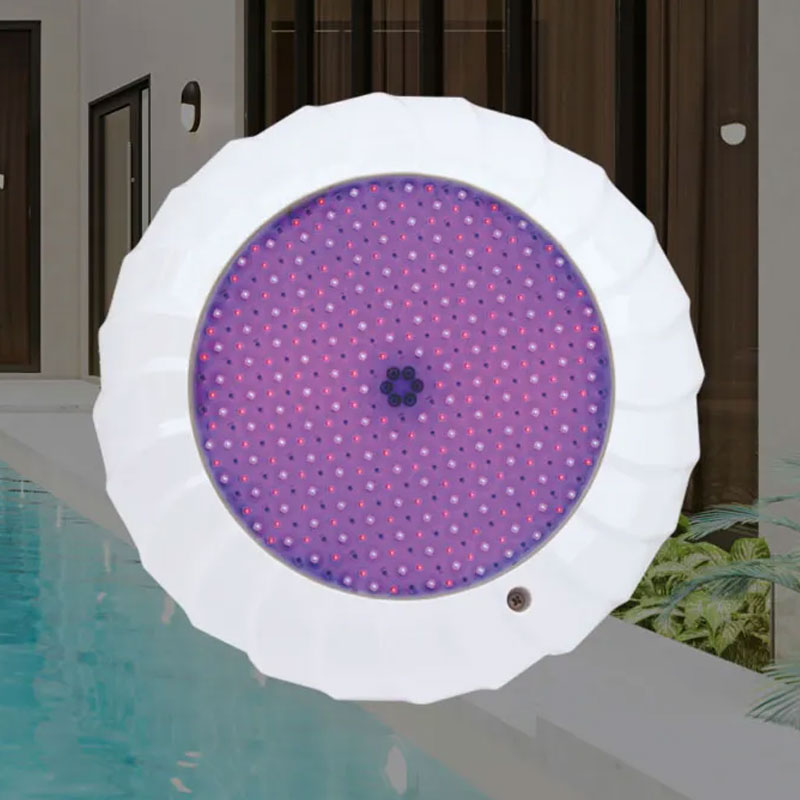
Wall mounted swimming pool lights are underwater luminaires fixed directly to the pool wall rather than installed inside a recessed niche. For existing pools, renovations and projects where cutting a new wall niche is undesirable, this installation method can simplify construction while still providing underwater illumination for visibility, ambience and architectural effect.
The right light should not be chosen by wattage or appearance alone. A pool-lighting specification should consider installation method, supply voltage, waterproof construction, corrosion resistance, optical distribution, glare, control method, cable routing, transformer capacity and future maintenance access. These factors determine whether a lighting system remains practical after the pool is commissioned.
AQUA currently offers multiple wall-mounted LED pool-light families together with recessed pool lights, transformers and RGB controls. Its wall-mounted range is designed for applications including residential pools, hotels, clubs, schools and other aquatic environments. This guide explains how contractors, distributors and project buyers can evaluate wall-mounted pool lights systematically instead of selecting only from a catalogue image.
What Are Wall Mounted Swimming Pool Lights?
Wall mounted swimming pool lights are underwater luminaires attached to the finished pool wall without requiring a conventional recessed niche inside the pool structure.
The installation method is the main characteristic that separates them from recessed or niche-mounted lights. A wall-mounted fixture is mechanically secured to the wall surface and projects slightly into the water. A recessed fixture, by contrast, is installed into a prepared opening so that the visible face is generally flush or close to flush with the finished wall.
This difference matters most during construction and renovation. On a new pool, the civil and electrical teams can reserve niches, conduits and junction points before waterproofing and finishing. On an existing pool, adding a recessed niche can involve cutting the structure, repairing waterproof layers and restoring tile or liner finishes. A surface-mounted solution can reduce that scope where the existing electrical layout and local installation rules permit it.
AQUA's current wall-mounted category includes AHT, ALE, ALB and ALP series products. The company states that selected designs use 12 V low-voltage power, IP68 enclosure protection and stainless-steel or corrosion-resistant plastic housings. These specifications should always be confirmed on the exact model data sheet because a category can contain products with different wattages, dimensions, materials and optical characteristics.
Why Choose Wall Mounted Swimming Pool Lights for Renovation Projects?
Wall mounted swimming pool lights are especially suitable for renovations because they can reduce the need to create a new recessed cavity in an existing pool wall.
Renovation work is often constrained by the structure already in place. The pool shell may be tiled, lined or coated, and the original light niche may not match a new fixture. In such cases, a wall-mounted light can provide a practical replacement strategy if the cable route, mounting surface and electrical safety requirements can be satisfied.
AQUA describes its wall-mounted lights as directly fixed to the pool wall without opening a new niche. The company also notes that its wall-mounted fixtures protrude approximately 5–10 cm from the wall depending on configuration. That projection should be considered in locations where swimmers pass close to the wall, particularly narrow training lanes, shallow teaching areas or pools with vigorous water movement.
The renovation advantage is not only installation time. Future access can also be simpler because the fixture is not buried deeply inside the structure. However, contractors should never assume that a surface-mounted fixture can be changed without considering cable length, junction-box position, isolation procedure and local electrical rules. Maintenance planning should be part of the original specification.
For a project already receiving search visibility for wall mounted swimming pool lights, the AQUA category provides a useful starting point for comparing the available wall-mounted product families before moving to an individual model.
Wall Mounted Swimming Pool Lights vs Recessed Pool Lights
Wall mounted swimming pool lights and recessed pool lights differ mainly in structural installation, visual profile, maintenance access and suitability for new-build versus renovation projects.
| Selection Factor | Wall Mounted Pool Light | Recessed Pool Light |
|---|
| Installation | Fixed to the finished pool wall | Installed into a prepared niche or wall opening |
| Best project stage | Renovations, replacements and some new pools | New pools or projects with niches planned in advance |
| Wall profile | Projects outward from the wall | Usually sits flush or close to flush |
| Civil work | Can reduce structural cutting when conditions allow | Requires correct niche dimensions and waterproof detailing |
| Maintenance access | Fixture body is readily accessible from the pool side | Access depends on niche, cable length and installation method |
| Aesthetic effect | Visible fixture body can become part of the pool design | Cleaner integrated appearance |
| Typical procurement concern | Projection, mounting strength and cable routing | Niche compatibility and waterproof structural detailing |
Neither type is universally better. A hotel renovation may favor surface mounting because disturbing the pool shell could increase downtime. A new competition or high-end architectural pool may favor a recessed light because a flush wall profile is important. The decision should therefore be made before selecting wattage, color or remote-control functions.
If the project requires a flush installation, AQUA also offers recessed underwater light products. Comparing the two categories at the layout stage is more useful than deciding after the waterproofing and finishing work has already been completed.
What Waterproof Rating Should Wall Mounted Swimming Pool Lights Have?
The waterproof specification for wall mounted swimming pool lights should be appropriate for continuous underwater service and verified against the applicable product standard and installation environment.
IP ratings describe an enclosure's resistance to ingress of solids and water under defined test conditions. IEC 60529 is the international reference used to classify degrees of protection provided by electrical enclosures. In the common IP68 designation, the first numeral indicates the highest standard dust-protection class, while the second numeral indicates protection for continuous immersion under conditions specified by the manufacturer.
IP68 should not be treated as a complete electrical-safety specification by itself. Pool luminaires also need suitable insulation, cable sealing, transformer arrangements, bonding or grounding where required, and installation in accordance with local codes. In North American projects, underwater luminaires may also be evaluated under standards such as UL 676, depending on product type and market requirements.
AQUA states that its wall-mounted pool-light designs use IP68 sealing, with tempered glass and stainless-steel or resistant plastic construction on selected products. B2B buyers should request the actual test report or certificate corresponding to the exact model ordered. A generic catalogue statement should not replace model-specific compliance documentation when the project specification requires independent verification.
During installation, the weakest point is often not the front lens but the cable entry, gland, gasket or junction. These interfaces should be assembled exactly as the manufacturer instructs. Cutting, splicing or resealing underwater cables with non-approved methods can defeat the protection provided by the original fixture design.
Why 12 V Power Is Common for Wall Mounted Swimming Pool Lights
Low-voltage wall mounted swimming pool lights commonly use a 12 V supply so the underwater luminaire can operate from a dedicated safety transformer appropriate to the installation.
AQUA states that selected wall-mounted LED pool lights use 12 V low-voltage power. The important design issue is that the transformer, cable and control system must all be sized for the connected lighting load and voltage drop. Simply specifying "12 V" is not enough for a long cable run or a large group of fixtures.
For example, if ten 18 W lights are installed on one lighting zone, the connected lighting load is 180 W before allowances for transformer losses, control equipment and design margin. The electrical designer should select transformer capacity using the manufacturer's requirements and verify that conductor size keeps voltage at the luminaire within its permitted range.
Long underwater-light circuits can experience noticeable voltage drop. A transformer that is technically large enough in watts may still produce poor lighting performance if cable resistance causes the voltage at distant fixtures to fall outside the operating range. This can lead to uneven brightness, unstable color control or premature electronic problems.
Transformers should also be selected for the destination market. Primary voltage and frequency may differ between countries, while the secondary output must match the actual luminaire. For B2B orders, the RFQ should state country, site voltage, number of fixtures, wattage per fixture, circuit grouping and approximate cable length.
How to Select LED Output for Wall Mounted Swimming Pool Lights
Selecting LED output for wall mounted swimming pool lights means balancing luminous performance, beam distribution, pool geometry, surface reflectance and visual comfort rather than choosing the highest wattage available.
AQUA states that selected wall-mounted products can reach around 90 lm/W luminous efficiency. This figure is useful as a product-performance reference, but the number of fixtures still depends on how that light is distributed underwater. A narrow beam can create bright patches and dark zones, while a well-controlled wide beam can illuminate a larger area more evenly.
Pool finish affects perception. Light-colored tile reflects more light than a dark finish, while deep water absorbs and scatters light differently from a shallow pool. A long rectangular lap pool may need a different fixture spacing strategy from a compact spa or free-form resort pool.
Glare should be considered from the swimmer's eye level and from viewing areas around the pool. AQUA describes three anti-glare approaches on its wall-mounted range: layered refraction, a honeycomb lens concept and concave optical divergence. It also states that warm-white options in the approximately 2500–3000 K range can be selected on relevant configurations. Buyers should confirm which optical system and color temperatures are available on the exact model.
For a general product comparison, the AQUA swimming pool light for sale category groups wall-mounted, recessed, landscape, transformer and remote-control options in one navigation path, making it easier to coordinate the complete lighting package instead of purchasing fixtures in isolation.
How Should Wall Mounted Swimming Pool Lights Be Positioned?
Wall mounted swimming pool lights should be positioned to provide useful underwater visibility and even illumination while minimizing glare, dark zones and obstructions to swimmers.
There is no single spacing rule that fits every pool. Layout depends on dimensions, depth, finish, beam angle, fixture output and the visual objective. A residential pool designed mainly for ambience may use fewer fixtures than a hotel or training pool where visibility and uniformity have greater importance.
One practical approach is to identify the main viewing direction. Where possible, lights can be positioned so that people on terraces, hotel rooms or lounge areas are not looking directly into the brightest part of the beam. Fixtures on the wall facing the main viewing area can create more glare than fixtures arranged to project away from that line of sight.
Stairs, entries, shallow shelves and changes in depth deserve additional attention because users need to perceive edges and level transitions. Lighting should support visibility without creating intense hotspots. In architectural pools, underwater lighting should also coordinate with deck, landscape and façade lighting so that one system does not overpower the others.
Before drilling mounting points, installers should mark fixture positions and verify cable routes, wall material, access and any expansion joints. The lighting layout should be coordinated with returns, skimmers, handrails and other fittings so the finished wall does not become visually or mechanically congested.
For large projects, a simple lighting mock-up can be valuable before the entire pool is equipped. Installing one or two fixtures at representative positions allows the project team to assess perceived brightness, glare, beam spread and color against the actual wall finish. This is especially useful when drawings alone cannot predict how dark tiles, textured finishes or reflective stainless-steel details will affect the scene.
Uniformity should also be considered separately from total output. Two layouts with the same connected wattage can look completely different if one concentrates light into a few bright zones while the other distributes it evenly. Contractors should therefore request photometric information where available and compare it with the pool geometry rather than assuming that more watts automatically produce a better result.
What Materials Are Best for Wall Mounted Swimming Pool Lights?
The best material for wall mounted swimming pool lights depends on water chemistry, corrosion exposure, mechanical requirements and the maintenance environment.
Stainless steel is widely used because it provides a strong, premium-looking housing, but the exact grade and fabrication quality matter. Corrosion resistance can be affected by chloride concentration, temperature, crevices, dissimilar metals and poor bonding practices. A stainless-steel appearance alone is therefore not proof of long-term suitability.
Engineering plastics can provide excellent chemical resistance and lower weight when correctly formulated for UV and pool-water exposure. AQUA currently offers wall-mounted designs using stainless-steel or acid- and alkali-resistant plastic housings. The supplier should identify the actual housing material for each model and provide the relevant operating limits.
Tempered glass or engineered polymer lenses must maintain clarity while resisting thermal and chemical stress. Gaskets should remain elastic under the expected temperature and chemical conditions. Cable jackets and seals also need compatibility with the pool environment.
For salt-treated or unusual water conditions, inform the supplier before ordering. A luminaire suitable for a conventional chlorinated pool should not automatically be assumed suitable for seawater or every high-salinity application. Market-specific certifications may distinguish fresh-water and seawater suitability.
How to Evaluate Wall Mounted Swimming Pool Lights for RGB and Controls
RGB wall mounted swimming pool lights require compatible drivers, transformers and controllers so multiple fixtures can change color reliably and remain synchronized.
Color-changing lighting adds another layer of system design. Buyers should confirm whether the light uses RGB or another color-control architecture, how fixtures are grouped, how many watts each controller supports and whether synchronization depends on power cycling, wired communication or a separate remote-control system.
For a hotel or commercial project, control zones should be defined before procurement. The main pool, spa and water feature may need different colors or operating schedules. If every fixture is placed on one large zone, maintenance or programming changes can affect the entire venue.
Transformer and controller capacity should be checked together. The total connected wattage, cable length and maximum devices per controller should remain within manufacturer limits. A practical RFQ includes a simple circuit schedule showing quantity, model, wattage, zone and cable distance.
Commercial operators should also consider replacement compatibility. If a controller is discontinued, can a new unit operate existing lights? If one light is replaced after several years, will its color output visually match the remaining fixtures? These lifecycle questions are often more important than the initial remote-control range.
Wall Mounted Swimming Pool Lights Procurement Checklist
A wall mounted swimming pool lights procurement checklist defines the installation, optical, electrical and documentation requirements needed to obtain comparable quotations.
Pool type, dimensions, depth range and wall finish.
New construction, renovation or replacement project.
Required wall-mounted or recessed installation method.
Fixture quantity and preferred wattage range.
White, warm white, RGB or other color requirement.
Beam distribution and anti-glare requirement.
Housing and lens material.
Required IP rating and market-specific compliance documentation.
Input voltage at the luminaire and transformer primary voltage.
Approximate cable length from transformer or junction point.
Transformer capacity and number of lighting zones.
Controller and synchronization requirement.
Water chemistry, salinity and operating temperature.
Mounting hardware and installation drawings.
Warranty, spare parts and replacement compatibility.
AQUA's current wall-mounted range includes multiple product families, so the technical team should select a model after receiving the pool layout and electrical requirements. For B2B projects, sending a drawing is more useful than requesting "a 12 V pool light" because the layout determines quantity, beam strategy, transformer load and cable routing.
Frequently Asked Questions About Wall Mounted Swimming Pool Lights
The following FAQs answer common design and procurement questions about wall mounted swimming pool lights.
1. Are wall mounted pool lights suitable for existing pools?
Yes. Their main advantage is that they can often be fixed to the finished wall without creating a conventional recessed niche. The existing electrical route, mounting surface and local safety requirements still need to be checked.
2. What is the difference between wall-mounted and recessed pool lights?
A wall-mounted light sits on the wall surface and projects into the pool. A recessed light is installed into a prepared niche and generally produces a flatter wall profile. Wall-mounted designs are often easier to adapt to renovations, while recessed designs are commonly planned during new construction.
3. Is IP68 enough to specify an underwater pool light?
No. IP68 is an important enclosure-protection classification, but a complete specification also includes electrical safety, cable sealing, transformer arrangement, product certification and installation according to local codes.
4. Why are many underwater pool lights 12 V?
Low-voltage operation is commonly used for underwater luminaires together with an appropriate safety transformer. The transformer, conductor size, voltage drop and installation rules must still be engineered for the project.
5. Can wall mounted swimming pool lights use RGB color control?
Yes, selected models can support RGB lighting. Confirm controller compatibility, transformer capacity, number of zones, synchronization method and replacement compatibility before ordering.
6. What project information should I send AQUA?
Send the pool dimensions, wall material, water depth, renovation or new-build status, preferred light color, fixture quantity, site voltage, cable distance and control requirements. A plan drawing helps AQUA recommend a more suitable lighting configuration.
Conclusion: Selecting Wall Mounted Swimming Pool Lights
Wall mounted swimming pool lights are most valuable when their installation method matches the project. They can simplify renovations and replacements by avoiding a new recessed niche, but they still require careful attention to waterproofing, low-voltage design, material compatibility, beam distribution, glare, cable routing and control architecture.
For AQUA projects, compare wall-mounted and recessed options before finalizing the wall finish and electrical drawings. Then select the exact fixture from verified model data rather than a category-level specification. This approach gives distributors, contractors and facility owners a lighting system that is easier to install, commission and maintain while supporting both underwater visibility and the desired visual effect.
References
IEC — Ingress Protection (IP) Ratings and IEC 60529
UL Solutions — UL 676 Standard for Underwater Luminaires and Submersible Junction Boxes
IEC Webstore — IEC 60529 Degrees of Protection Provided by Enclosures
 English