A pool skimmer for leaves is a manual cleaning tool designed to collect floating or submerged debris before that material breaks down, reaches the circulation system or makes the pool difficult to maintain. Although the tool is simple, frame shape, mesh depth, net material, pole compatibility and the type of debris being collected all affect how efficiently it works.
The biggest source of confusion is the word "skimmer." A leaf skimmer is a handheld net used by an operator. A wall skimmer is a permanently installed part of the circulation system that draws surface water into the filter. Both remove debris, but they work in completely different ways and belong to different product categories.
AQUA currently lists six leaf-skimmer models, including shallow and deep designs as well as aluminum- and plastic-frame options. Its range is intended for residential and commercial pool cleaning and can be paired with telescopic poles and other maintenance tools. This guide explains how to select and use the right skimmer according to debris load, pool size and cleaning routine.
What Is a Pool Skimmer for Leaves?
A pool skimmer for leaves is a handheld frame-and-net tool used to scoop leaves, insects and other debris from the water surface or from below the surface.
The tool normally consists of a rigid frame, mesh net and pole connector. The operator pushes or pulls the frame through the water so debris enters the net. A shallow net is easy to move and empty, while a deep bag holds more material and is useful for heavier cleaning.
AQUA's current leaf-skimmer range includes AQ-1001 and AQ-1002 luxury models, AQ-9015 and AQ-9016 aluminum models, and AQ-9017 and AQ-9018 plastic models. Within these six products, standard and deep-net versions give buyers a choice between fast surface collection and greater debris capacity.
The category should not be confused with a fixed skimmer box. Searchers often use "pool skimmer" for both tools, which is why a good product specification should identify whether the buyer needs a net, a telescopic pole accessory or a built-in circulation fitting.
Pool Skimmer for Leaves vs Wall Skimmer: What Is the Difference?
A pool skimmer for leaves is a manual cleaning tool, while a wall skimmer is a fixed hydraulic fitting that continuously draws surface water into the pool circulation system.
| Comparison | Pool Leaf Skimmer | Wall Skimmer |
|---|
| How it works | Operator moves a net through the water | Circulation pump draws surface water through an opening |
| Main purpose | Remove visible leaves, insects and debris on demand | Continuously collect floating debris and send water to filtration |
| Installation | No permanent installation; usually connects to a telescopic pole | Built into or mounted on the pool wall and connected to piping |
| Debris capacity | Depends on shallow or deep net design | Depends on skimmer basket and circulation system |
| Best use | Daily manual maintenance and localized cleanup | Part of the permanent hydraulic circulation system |
| Maintenance | Empty and rinse the net | Empty the basket and maintain suction flow |
This distinction matters for keyword and product selection as well as maintenance. Someone searching for a handheld pool skimmer for leaves usually wants a net that can be moved around the pool. A buyer designing the circulation system needs a skimmer opening, basket, suction pipe and compatible pump instead.
The two products complement each other. A wall skimmer can continuously capture small floating debris, while a handheld leaf skimmer lets an operator remove a cluster of leaves quickly before they spread around the pool or overload the fixed skimmer basket.
Standard vs Deep Pool Skimmer for Leaves
Standard and deep pool skimmers for leaves differ mainly in net profile, water resistance, debris capacity and the depth at which they are most convenient to use.
A standard leaf skimmer uses a relatively shallow or flat net. AQUA describes this style as suitable for quick daily surface cleaning of floating leaves, insects and light debris. Because the net has less volume, it creates less drag and is easy to maneuver around edges and steps.
A deep leaf skimmer uses a bag-shaped net that can hold more debris. AQUA describes its deep models as suitable for collecting submerged leaves, twigs and bulkier material while reducing how often the operator has to empty the net. This is useful after storms, landscaping work or periods when the pool has not been cleaned regularly.
The deeper net is not automatically better for every task. When only a few leaves are floating on the surface, a shallow net is faster to sweep, turn and empty. For a large outdoor pool with heavy tree debris, the extra capacity of a deep net can save repeated trips to the waste bin.
A practical commercial facility may keep both types. The standard skimmer can be used during routine opening checks, while a deep bag is used for heavier periodic cleaning or when debris sinks below the surface.
How to Choose the Mesh on a Pool Skimmer for Leaves
The mesh on a pool skimmer for leaves should be fine enough to capture the target debris without creating unnecessary water resistance or becoming difficult to clean.
Large leaves are easy to catch with an open mesh, but pollen, small insects and fine particles require a tighter net. AQUA states that its leaf-skimmer range uses fine mesh capable of retaining small material such as pollen and sand while also holding larger leaves. Actual mesh construction should be confirmed on the selected model if a project has a specific particle-size requirement.
Fine mesh increases drag. An operator sweeping a dense fine-mesh bag rapidly through deep water will feel more resistance than with an open flat net. This matters for hotel or aquatic-center staff who may clean large surface areas every day.
Net anchoring is another quality point. Debris loads and repeated pulling stress the joint between the mesh and the frame. Reinforced attachment can reduce tearing, particularly on deep bags that may become heavy when filled with wet leaves.
For buyers sourcing swimming pool cleaning equipment, it is useful to treat leaf skimmers, brushes, vacuum heads, hoses and poles as a maintenance system. The ideal mesh depends partly on which tasks will be handled by other tools.
Which Frame Material Is Best for a Pool Skimmer for Leaves?
The best frame material for a pool skimmer for leaves depends on weight, rigidity, chemical exposure, handling frequency and the type of pool surface being cleaned.
AQUA currently lists both aluminum and plastic-frame leaf skimmers. Aluminum provides a rigid frame and a professional feel while keeping weight relatively low. Plastic can offer corrosion resistance, smooth edges and a lower risk of scratching sensitive finishes when correctly designed.
The supplier's material description should be more specific than "metal" or "plastic." Ask whether the aluminum is coated or treated, what polymer is used in the frame, and how the connector is reinforced. Outdoor tools are exposed not only to chlorinated water but also to sunlight, heat and repeated impact against deck surfaces.
AQUA states that selected plastic-frame products use high-impact material intended to resist pool chemicals. The company also emphasizes smooth, rounded edges for use on surfaces including vinyl liners and fiberglass. Buyers should still inspect samples if the tool will be used on a premium finish where scratching is a major concern.
For commercial operations, replaceable nets or compatible spare parts can be more important than the initial frame material. A strong frame has little value if the net cannot be repaired or replaced economically after heavy use.
How Does Pole Compatibility Affect a Pool Skimmer for Leaves?
Pole compatibility determines the working reach and handling flexibility of a pool skimmer for leaves, especially in large, deep or irregularly shaped pools.
A leaf-skimmer head is normally used with a telescopic pole so the operator can clean without entering the water. The connector should fit securely, release without tools when required and resist twisting when the net is loaded.
AQUA states that its current leaf-skimmer design uses a 360° rotatable universal cuff intended for connection with standard telescopic poles. The purpose of the rotating connector is to improve angle control near corners and edges. Buyers should confirm actual pole diameter and locking mechanism before mixing products from different manufacturers.
Reach should match the pool. A compact residential pool may need only a short pole, while a hotel or public pool can require greater reach from the deck. Excessively long poles are harder to control, so the goal is not simply maximum length but enough reach to cover the pool efficiently.
When multiple maintenance tools share one pole system, standardization can reduce storage space and simplify replacement. A facility can use compatible heads for leaf skimming, brushing and vacuuming rather than maintaining separate poles for every task.
How to Use a Pool Skimmer for Leaves Efficiently
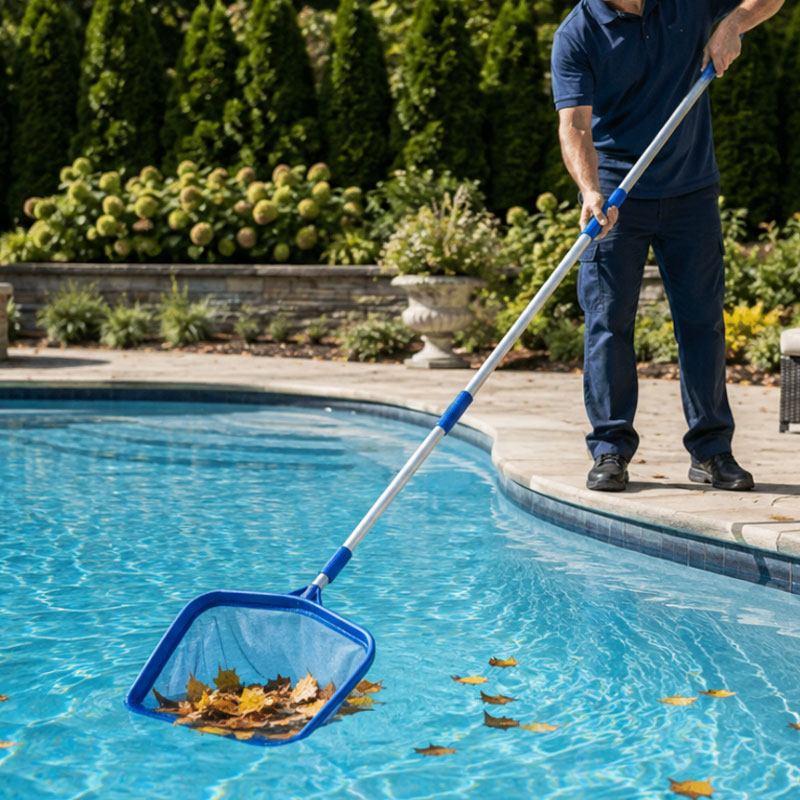
Using a pool skimmer for leaves efficiently means removing debris with controlled sweeping motions before it becomes waterlogged, sinks or reaches the filtration system.
Start with floating debris. Move the net slowly enough that leaves enter the mesh rather than being pushed away by a bow wave. Sweep along the downwind or circulation side of the pool where debris naturally collects. Empty the net before it becomes so full that water flow through the mesh is restricted.
For submerged debris, approach from below or at a shallow angle. A deep bag works better when leaves have sunk to steps or the pool floor. Avoid scraping the frame aggressively across delicate finishes.
Cleaning frequency should respond to the environment. An outdoor pool surrounded by trees may need several quick passes each day during leaf season, while an indoor pool may require only occasional manual skimming. Removing debris early reduces the amount that reaches baskets and filters.
CDC swimming guidance notes that filters remove debris such as leaves and that debris can consume disinfectant that is needed to control germs. Manual leaf removal does not replace filtration or disinfection, but it reduces unnecessary organic loading and supports the broader maintenance process.
After cleaning, rinse the net with fresh water where practical and allow it to dry. Inspect the mesh, frame and connector for tears or cracks before the next use, especially in commercial facilities where tools are used by multiple operators.
The direction of pool circulation can make manual skimming more efficient. Returns often push floating material toward particular edges or corners, while wind creates another collection pattern outdoors. Instead of walking around the entire perimeter randomly, an operator can identify these accumulation zones and clear them first. This reduces cleaning time and removes a large proportion of visible debris with fewer passes.
Debris should also be removed before brushing or vacuuming when possible. Brushing can break fragile leaves into smaller pieces and spread them through the water, while vacuuming large leaves can clog a hose or vacuum head. A sensible sequence is to skim large material first, brush surfaces second and vacuum settled fine debris last.
In a commercial maintenance log, leaf load can be used as a practical operating indicator. A sudden increase after landscaping work, strong winds or seasonal leaf fall may justify temporary additional skimming rounds. The facility does not need a complicated measurement system; recording whether debris load is light, moderate or heavy can help supervisors schedule labor and prevent repeated basket blockages.
How a Pool Skimmer for Leaves Supports the Filtration System
A pool skimmer for leaves supports filtration by removing large debris before that material reaches skimmer baskets, pump strainers or filter media.
Large leaves can block a wall-skimmer basket or pump strainer and reduce circulation. When flow decreases, the filtration and treatment system may not operate at its intended condition. Removing visible debris manually can therefore reduce avoidable loading on hydraulic components.
This does not mean a leaf skimmer replaces a permanent surface-skimming system. The fixed swimming pool surface skimmer remains part of the circulation design, collecting floating material continuously when the pump is operating. The handheld net provides targeted cleaning that the fixed system cannot always perform quickly.
For facilities with heavy landscaping, maintenance procedures can define a sequence: manually remove large debris, empty wall-skimmer baskets, inspect the pump strainer and then check filter pressure. This keeps one overloaded component from masking a problem elsewhere in the system.
During storms or periods of exceptional debris, the operator may need to repeat manual skimming several times before returning the circulation system to normal. A deep skimmer can be particularly useful because it holds more material per pass.
How to Choose a Pool Skimmer for Leaves for Residential and Commercial Pools
Choosing a pool skimmer for leaves for residential or commercial use depends on pool size, debris load, cleaning frequency, staff workload and the need for replaceable or standardized components.
A homeowner may value low weight, simple connection and easy storage. One standard shallow skimmer can be sufficient if the pool is screened or has limited landscaping. A deep net becomes more useful where large leaves or seed pods regularly enter the water.
A hotel, club or public pool should consider durability and operator efficiency. Staff may clean several pools or a much larger water surface each day. Reinforced nets, standardized telescopic-pole connections and the ability to keep spare heads on site become more important.
AQUA currently lists six leaf-skimmer models across standard/deep and aluminum/plastic configurations. This gives buyers a simple matrix: first choose shallow or deep capacity, then choose the preferred frame construction and connector style. The exact product should be selected after considering the facility's debris profile.
Commercial purchasers should also consider packing quantity, spare nets, replacement heads and compatibility with existing poles. A small difference in unit price matters less when a tool is inconvenient for staff or cannot be replaced quickly during peak season.
Pool Skimmer for Leaves Buying Checklist
A pool skimmer for leaves buying checklist helps buyers compare net capacity, materials, handling and compatibility instead of purchasing only by appearance.
Identify whether the primary task is floating or submerged debris.
Choose standard shallow net or deep collection bag.
Confirm mesh density for leaves, insects, pollen and finer debris.
Check frame material and resistance to pool chemicals.
Inspect edge shape for compatibility with vinyl, fiberglass or other sensitive surfaces.
Confirm connector diameter and telescopic-pole compatibility.
Check whether the connector rotates or locks in multiple positions.
Consider total tool weight for long cleaning sessions.
Ask whether nets or complete heads are replaceable.
Check packaging and carton quantity for distributor orders.
Consider keeping both shallow and deep styles for commercial sites.
Confirm cleaning and storage recommendations.
For a B2B quotation, state the required model style, frame material, expected quantity, destination market and whether telescopic poles or other cleaning tools are needed in the same shipment. Bundling compatible maintenance tools can simplify procurement and reduce the risk of mismatched connectors.
For B2B procurement, the final decision should always be checked against the actual application rather than a generic catalogue description. Confirm the selected model, materials, operating conditions, installation interfaces, documentation and spare-parts requirements in the purchase specification so that both supplier and buyer are working from the same approved configuration.
For distributor orders, it is also useful to confirm carton quantity, replacement availability and whether the same pole interface is used across multiple skimmer heads. Standardized accessories can simplify stock planning, training and after-sales support.
Frequently Asked Questions About a Pool Skimmer for Leaves
The following FAQs answer common questions about selecting and using a handheld pool skimmer for leaves.
1. Is a pool leaf skimmer the same as a wall skimmer?
No. A leaf skimmer is a handheld net used for manual cleaning. A wall skimmer is a fixed part of the pool circulation system connected to suction piping and a pump.
2. Is a deep leaf skimmer better than a flat skimmer?
A deep net holds more debris and is better for heavy or submerged leaves. A flat or shallow skimmer creates less drag and is often faster for light daily surface cleaning. Many commercial facilities benefit from keeping both.
3. What mesh should I choose for small debris?
Use a finer mesh when pollen, insects and small particles are common. Remember that finer mesh creates more water resistance, so frame strength and handling comfort become more important.
4. Can I use a pool skimmer for leaves on a vinyl liner?
Yes, if the frame has smooth, rounded edges and is intended for sensitive surfaces. Avoid dragging damaged or sharp frames across the liner.
5. How often should leaves be removed from a pool?
Remove visible leaves as early and as often as practical, especially in outdoor pools. Frequent light cleaning is usually easier than allowing debris to become waterlogged, sink or overload baskets and filters.
6. What leaf-skimmer options does AQUA offer?
AQUA currently lists six leaf-skimmer models, including standard and deep designs with luxury, aluminum and plastic-frame configurations. The range can be paired with compatible telescopic poles and other cleaning equipment.
Conclusion: Choosing the Right Pool Skimmer for Leaves
A pool skimmer for leaves is a simple tool with a clear maintenance role: remove visible debris quickly before it sinks or adds unnecessary load to the circulation system. The most important choice is between a shallow standard net for fast daily cleaning and a deep bag for heavier debris collection.
Frame material, fine-mesh performance, pole compatibility, edge design and replacement availability then determine how practical the tool will be in real use. AQUA's six-model leaf-skimmer range gives residential and commercial buyers several combinations of depth and construction. By matching the skimmer to the debris load and pairing it with the right pole and cleaning routine, operators can keep the pool surface cleaner while reducing avoidable stress on baskets, strainers and filters.
References
CDC Healthy Swimming — How Filters and Disinfectants Work Together
CDC Healthy Swimming — Using a Net to Remove Pool Contamination
CDC Healthy Swimming — Pool Chemical Safety and Housekeeping
 English